One orchestrator.Every workflow.

Build, run, and govern across your entire organization.
Agentic AI under the same controls.
- Declarative
- Language-Agnostic
- 2,300+ Plugins
- Cloud
- Self-Hosted
- API-First


Build, run, and govern across your entire organization.
Agentic AI under the same controls.


Kestra scales because it is designed for cross-team orchestration from day one.
Standardize Terraform, Ansible, CI/CD and operational workflows across hybrid and air-gapped environments.
faster infrastructure delivery
lower legacy tooling cost
Run ingestion, transformations, dbt, Airbyte, Spark and quality checks in one workflow engine.
Faster Pipeline Delivery
Fewer Manual backfills
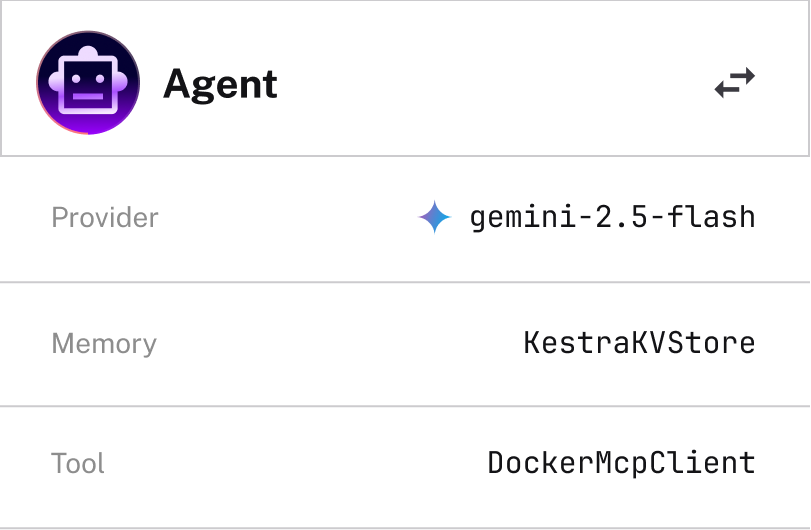
Agents, RAG pipelines, evaluation, publishing, retraining all orchestrated with governance and observability.
less pipeline maintenance
faster AI delivery cycles
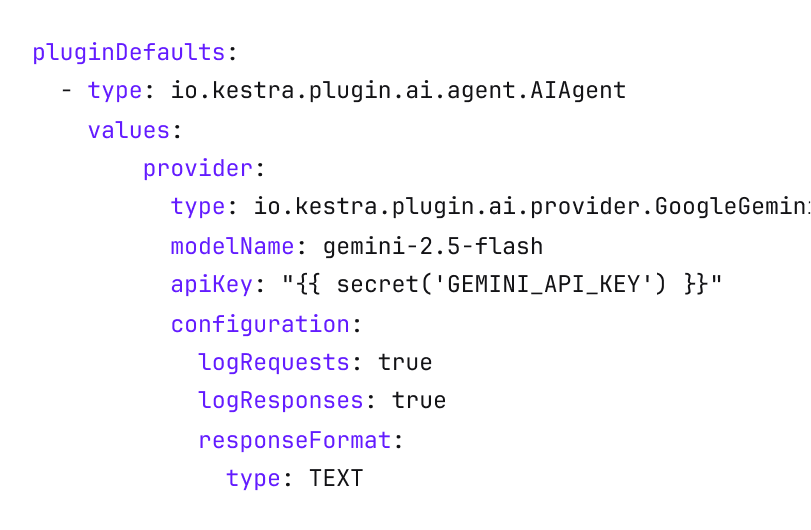
Write workflows in YAML. Version them. Review them. Ship them.
Cloud, data, infra, CI/CD, ITSM, messaging. Plug into your entire stack.
2,300+ plugins
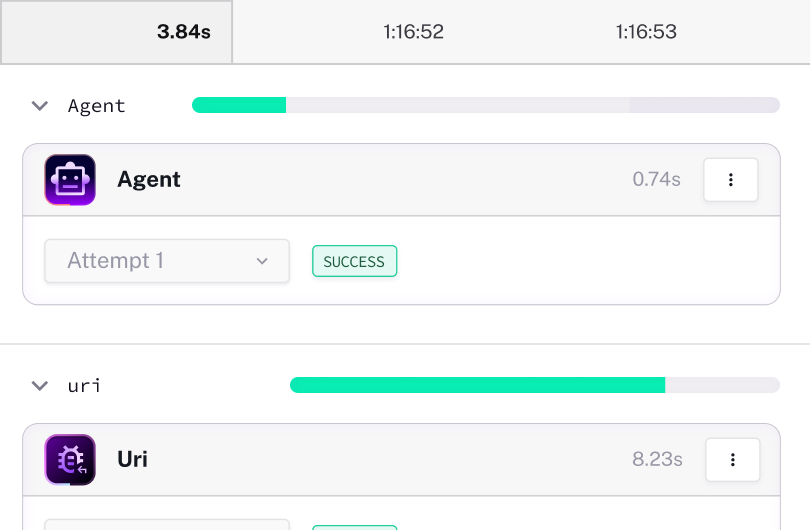
Cron, events, webhooks, messages. One engine to run them all.
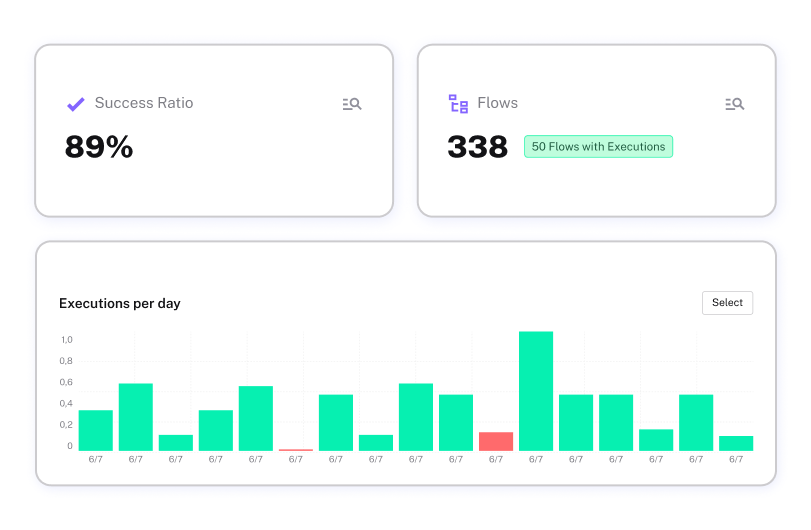
Retries, timeouts, SLAs, RBAC, audit logs. SOC 2, Built to run in production.
Run tasks in Python, Bash, Node.js, Go, or containers. No refactoring required.
Empower every team member to collaborate from a single tool—code for developers, UI for everyone else, all in sync.
Copilot for speed, agents for action. Create, iterate, and automate workflows with an AI native platform.
Trigger executions, manage workflows and resources through the API, and roll out updates safely with Git-driven CI/CD pipelines.
Kestra integrates with your existing cloud, data, infrastructure, and SaaS tools.
With 2,300+ plugins, you can orchestrate everything without building custom glue code.


We processed billions of rows and thousands of weekly API pulls in under 3 months. For the first time, our analysts aren't waiting for engineering—they're building the workflows themselves.

Self-host on Docker or Kubernetes. Free Forever

Built for critical environments.
SSO, RBAC, audit logs, multi-tenancy. Isolated workers and dedicated task runners.
Hybrid environments: Cloud, On-Prem, Air-Gapped.
SLA-backed support and a dedicated customer success program.
Managed platform, production-ready, scalable. Fastest time to value.
Jump-start your workflows with a growing library of workflow templates
Audits Microsoft Access databases for transaction ledger mismatches, unposted backlogs, and automates audit hold remediation.


Map changed monorepo paths to package test targets, loop only the selected suites, and escalate paths no package covers.


Audit MySQL accounts for anonymous users, empty passwords, remote root, global admin privileges and wildcard hosts, alert Slack, and optionally drop, lock or revoke and verify, never touching the connected account.


Proactively detect long-running uncommitted MySQL transactions and row lock contention before thread pool exhaustion occurs.
Catch a MySQL server left running with InnoDB redo logging disabled after a bulk load, turn it back on behind a dry-run and approval gate, then re-read the Innodb_redo_log_enabled status variable and fail the run if crash recovery is still off.

Checksum every table on the primary and its replicas, preview the repair with pt-table-sync, apply it through the primary after approval, and prove the replicas match.
Compute the binary log purge boundary from every replica's own read position and the last backup, alert Slack, then purge behind an approval with a re-check that fails if a needed log went missing.
Detect MongoDB documents whose embedded array is growing toward the 16MB BSON limit, archive the overflow, trim each array to its newest entries behind an approval and re-measure to prove it.


Match the bank statement to the ledger in four passes, classify every leftover item, prove the difference is explained, propose journals, require approval above a limit, and lock the period.

Monitor MySQL for long-running uncommitted transactions holding row locks, alerting DBAs on Slack to prevent lock wait timeouts.
Find a MySQL replica that accepts client writes because super_read_only is OFF, set it ON behind a dry-run and approval gate, then re-read both variables and fail if the replica is still writable. An instance with no replication configured is never touched.
Find the MongoDB documents that do not match their collection validator, backfill a missing required field behind an approval, then re-read the collection and fail the run if any repairable violator is left.
Audit MongoDB collections using $indexStats to detect unused secondary indexes consuming RAM, alerting DBAs on Slack.
Sample tempdb usage on a schedule or webhook, escalate to Slack and GitHub above your threshold, and keep per-file recommendations.

A scheduled Subscribe task listens for device heartbeats in a short window, alerts Discord and fails the run when zero messages arrive, and logs the count otherwise.


Detect MongoDB documents older than a retention window, alert Slack, then delete them behind an approval and re-read the collection to prove none remain.


Detect MongoDB documents sharing a business key no unique index could prevent, keep one survivor per key, delete the surplus behind an approval, then re-group to prove each key is unique.
Read-only check of a Moodle site's assignments and submissions on a schedule, paging Slack when marked feedback is overdue or the site cannot be read.

Reconcile a denormalized MongoDB read model against its PostgreSQL source of truth, find orphaned and stale documents by reading the keyset from PostgreSQL, alert Slack, then behind an approval gate delete and refresh them and re-verify.

Detect orphaned binary chunks in MongoDB GridFS with $lookup, pause for operator confirmation, purge confirmed orphans, and reverify zero residual storage leaks.


Kestra gives you fewer tools to maintain, fewer scripts to debug, fewer dependencies between teams, and one place to see what’s running
across your company.